
Home
»
 STANDARD PARTS »
Access equipments » Hinges and hooks (Series 37)
STANDARD PARTS »
Access equipments » Hinges and hooks (Series 37)
Hinges and hooks (Series 37)
Emile Maurin's industrial hinges, door hinges, door pivots, door hinges , and door slides are designed to articulate doors, hatches, covers, and technical panels in all industrial environments.
Reliable and robustly engineered, these hinges facilitate access, servicing, and maintenance of installations, with opening angles of up to 270° depending on the model.
Available in steel, stainless steel, aluminum, zamac, acetal, technopolymer , and nylon , they meet all specifications. The hinges come standard in black, white, or gray, with the option to customize dimensions and colors upon request. [ Read more ]
Reliable and robustly engineered, these hinges facilitate access, servicing, and maintenance of installations, with opening angles of up to 270° depending on the model.
Available in steel, stainless steel, aluminum, zamac, acetal, technopolymer , and nylon , they meet all specifications. The hinges come standard in black, white, or gray, with the option to customize dimensions and colors upon request. [ Read more ]


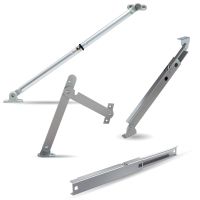
FAQ - Hinges and Hinge Pins
1. Which hinge should I choose so that a door stays open on its own, at any angle ?
A friction hinge keeps the door in the open position at any angle thanks to a constant rotational torque. This torque can be symmetrical (the same when opening and closing), asymmetrical (different depending on the direction), or unidirectional (active in only one direction).
2. What is the difference between a friction hinge and an indexing hinge ?
A friction hinge holds the door at any angle using a constant torque, while an indexing hinge locks it only at predefined angles (for example, 120° and 170°), with a click that is noticeable as it passes through each position.
3. What tightening torque should be used for a friction hinge ?
The available tightening torque generally ranges from 0.56 Nm to 4.97 Nm depending on the model and should be adjusted according to the weight and dimensions of the panel to be held in place.
4. What are the main criteria for choosing the right industrial hinge ?
The key criteria are: the load to be supported, exposure to vibrations, chemicals, or the elements, the panel's center of gravity, design requirements (visible or hidden), and the potential need for a secure opening mechanism.
5. Why choose Emile Maurin hinges over another supplier ?
Emile Maurin offers a wide range of hinges (friction, indexing, damped, hidden, and electric-contact) in a variety of materials, from steel and stainless steel to engineering plastics, as well as custom versions in various sizes and colors.
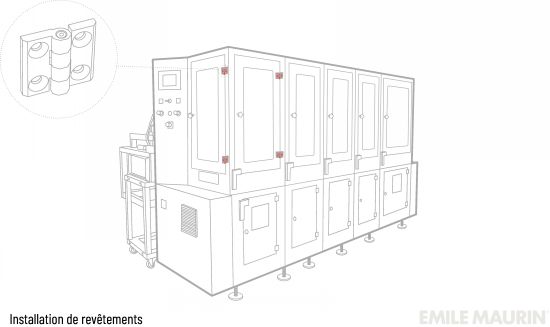
Exemples d'application :
Access Emile Maurin's technical resources :
>Hinges, Hinge Pins, and Hinge Shafts - Technical Data Sheet.PDF
>Hinges, Hinge Pins, and Hinge Shafts: Which One Should You Choose ?
1. Which hinge should I choose so that a door stays open on its own, at any angle ?
A friction hinge keeps the door in the open position at any angle thanks to a constant rotational torque. This torque can be symmetrical (the same when opening and closing), asymmetrical (different depending on the direction), or unidirectional (active in only one direction).
2. What is the difference between a friction hinge and an indexing hinge ?
A friction hinge holds the door at any angle using a constant torque, while an indexing hinge locks it only at predefined angles (for example, 120° and 170°), with a click that is noticeable as it passes through each position.
3. What tightening torque should be used for a friction hinge ?
The available tightening torque generally ranges from 0.56 Nm to 4.97 Nm depending on the model and should be adjusted according to the weight and dimensions of the panel to be held in place.
4. What are the main criteria for choosing the right industrial hinge ?
The key criteria are: the load to be supported, exposure to vibrations, chemicals, or the elements, the panel's center of gravity, design requirements (visible or hidden), and the potential need for a secure opening mechanism.
5. Why choose Emile Maurin hinges over another supplier ?
Emile Maurin offers a wide range of hinges (friction, indexing, damped, hidden, and electric-contact) in a variety of materials, from steel and stainless steel to engineering plastics, as well as custom versions in various sizes and colors.
Exemples d'application :
Access Emile Maurin's technical resources :
>Hinges, Hinge Pins, and Hinge Shafts - Technical Data Sheet.PDF
>Hinges, Hinge Pins, and Hinge Shafts: Which One Should You Choose ?