
Home
»  LEVELLING FEET, ANTI-VIBRATION, GUIDE ROLLERS AND CASTERS


The Emile Maurin line of feet , vibration dampers, rollers, and casters covers all support, stabilization, and mobility needs for industrial equipment.
Whether your machines are stationary, mobile, or subject to vibrations, the range offers the right solution for loads ranging from 30 to 500 kg: feet for stabilizing and leveling, vibration dampers for absorbing shocks and reducing noise, rollers for guiding linear movement, and wheels and casters for making carts, industrial furniture, and material-handling equipment mobile.
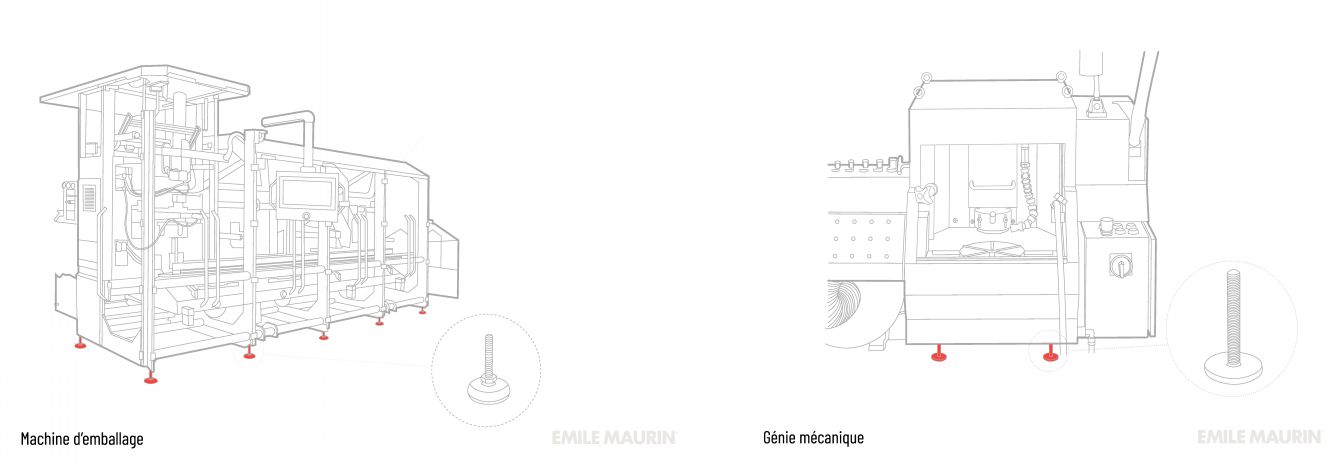
Machine feet ensure leveling and load distribution for all types of installations: machining, food processing, cleanrooms, and corrosive environments, with EHEDG-certified hygienic versions and models resistant to high-pressure cleaning.
Anti-vibration mounts limit the transmission of vibrations and noise between a machine and its support, protecting both the equipment and the work environment.
Guide rollers enable linear or pivoting movements on rails and industrial mechanisms. Quiet and wear-resistant, they ensure smooth rolling thanks to their low-friction tread.
Wheels and casters cover all mobility needs, from light furniture to heavy-duty material-handling carts, with options including stainless steel, medical,hygienic, and immobilization models.
[ Read more ]


FAQ - Feet, Anti-Vibration Mounts, Rollers, and Casters
What is the difference between a machine foot and an anti-vibration mount?
A machine foot is primarily used to stabilize and level stationary equipment. A vibration isolator adds vibration-damping capabilities through an elastic element (rubber, spring), which is useful for machines that generate shocks, noise, or oscillations that disturb the surrounding environment or cause structural fatigue.
What is the difference between a roller and a castor?
A roller is a wheel mounted on an axle and designed to guide movement (along a rail, cam, or mechanism). A caster is a complete assembly consisting of a wheel and a bracket (fixed or swiveling) that allows equipment to move in multiple directions.
Which caster should you choose based on the load to be moved?
It depends on the application. For light furniture, allow 15 to 130 kg per caster (Ø 14 to 150 mm). For intralogistics (carts, factory conveyor systems), 120 to 1,200 kg per caster (Ø 80 to 400 mm) with reinforced mounts. Stainless steel casters are suitable for the food industry and high temperatures, up to 280°C. Medical casters, on the other hand, prioritize maneuverability and a centralized locking mechanism over maximum load capacity.
What is an EHEDG-compliant hygienic foot?
A hygienic foot with an H-NBR base meets sanitary design requirements and is EHEDG- and 3A-certified: smooth surfaces with no retention areas, quick and effective cleaning, and resistance to chemicals.
Disinfection. Ideal for the food processing, healthcare, and medical industries.
Examples of applications :
Available technical resources :
To help you choose and install your feet, vibration dampers, rollers, and casters, Emile Maurin offers :
>Machine feet - Technical data sheet.PDF
>Rubber stops and anti-vibration pads - Technical data sheet.PDF
>Wheels and casters
>All types of rubber stops and anti-vibration pads
What is the difference between a machine foot and an anti-vibration mount?
A machine foot is primarily used to stabilize and level stationary equipment. A vibration isolator adds vibration-damping capabilities through an elastic element (rubber, spring), which is useful for machines that generate shocks, noise, or oscillations that disturb the surrounding environment or cause structural fatigue.
What is the difference between a roller and a castor?
A roller is a wheel mounted on an axle and designed to guide movement (along a rail, cam, or mechanism). A caster is a complete assembly consisting of a wheel and a bracket (fixed or swiveling) that allows equipment to move in multiple directions.
Which caster should you choose based on the load to be moved?
It depends on the application. For light furniture, allow 15 to 130 kg per caster (Ø 14 to 150 mm). For intralogistics (carts, factory conveyor systems), 120 to 1,200 kg per caster (Ø 80 to 400 mm) with reinforced mounts. Stainless steel casters are suitable for the food industry and high temperatures, up to 280°C. Medical casters, on the other hand, prioritize maneuverability and a centralized locking mechanism over maximum load capacity.
What is an EHEDG-compliant hygienic foot?
A hygienic foot with an H-NBR base meets sanitary design requirements and is EHEDG- and 3A-certified: smooth surfaces with no retention areas, quick and effective cleaning, and resistance to chemicals.
Disinfection. Ideal for the food processing, healthcare, and medical industries.
Examples of applications :
Available technical resources :
To help you choose and install your feet, vibration dampers, rollers, and casters, Emile Maurin offers :
>Machine feet - Technical data sheet.PDF
>Rubber stops and anti-vibration pads - Technical data sheet.PDF
>Wheels and casters
>All types of rubber stops and anti-vibration pads